“in all my life i had not known the secrets of landscape, until one morning, [in exile] i arrived in it boldly, and was startled.” — wang shen (c. 1048–1104)
wang shen was part of what scholars have called the ‘chinese literati,’ essentially a group of elite, learned men who were both politically entrenched and of great personal accomplishment (Bush 2012). wang descended from a long line of military generals, the progenitor of which is associated with the establishment of the Song dynasty itself (a synopsis of his life can be found here). despite his political prestige and artistic accomplishments, wang was exiled in 1080 from the court of the song emperor shenzong (c. 1048–1085), who was also his brother-in-law, amid the political climate shaped by contemporary politician Wang Anshi’s reforms (for context, see here). the translated extract of the poem above appears in art historian richard barnhart’s influential essay, in which he detects a “profound transformation” (Barnhart 1994, p. 195) in chinese landscape painting around the moment of wang’s banishment. interestingly, alfreda murck’s translation (2000, p. 136) does not include the phrase “in exile,” which barnhart introduces in square brackets, indicating it is an interpretive addition rather than part of the original text:
“All my life I had not reflected on landscape caverns, Once I myself arrived, I was startled!”
while it is possible that exile exposed wang to new landscapes, treating it as the driving force behind his artistic innovation may risk overdetermining the relationship between his political status and artistic production.
wang shen was exiled to the Junzhou region (present-day Danjiangkou in Hubei), home to the gorgeous wudang mountains. barnhart sees this moment as a turning point in the northern song painting tradition, marking a move away from the monumental court landscapes associated with artists such as Guo Xi (c. 1020–1090) toward a more indeterminate and spatially attenuated pictorial mode in wang shen’s work. in his interpretation, guo xi’s paintings represent an ordered and hierarchical vision, one that barnhart explicitly characterises in terms of “morality, virtue, strength, clarity, certainty, hierarchy … and a fixed, comprehensible, and permanent order” (barnhart 1994, p. 197). Exile, by contrast, is said to produce a relaxation of structural hierarchy, and a corresponding loss of stability or orientation (barnhart 1994, p. 200 and 205). Murck precociously extends this argument into the realm of poetry, reading the inscriptions accompanying such paintings as forms of coded political dissent shaped by displacement or loss of favour in the imperial court (Murck 2000). both barnhart and murck have been situated within an art-historiographical tendency that closely aligns painting with literary interpretation (Murray 1994, p. 358), a framework that helps explain the degree to which their readings privilege textual and symbolic meaning within the pictorial field.
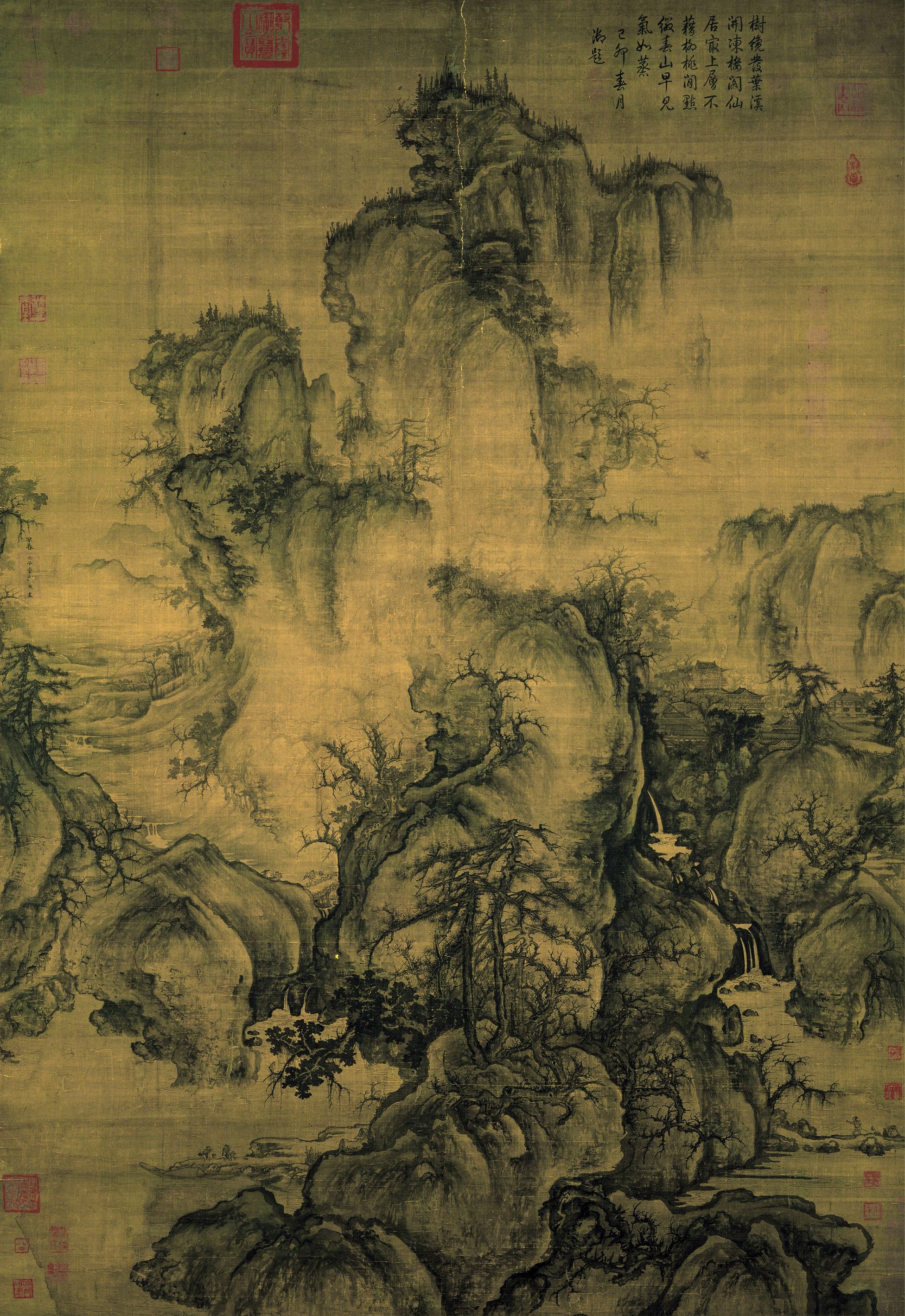
Barnhart starts with Guo Xi’s Early Spring, painted in 1072. It’s a six-foot hanging scroll in the National Palace Museum in Taipei, generally treated as one of the period’s definitive works. Guo Xi was Emperor Shenzong’s personal painter, and Barnhart reads this work as an allegory, where the central pine represents the emperor with the surrounding elements arranged in ordered, hierarchical subordination. his interpretation is based on Guo’s own views on composing landscape paintings:
“A tall pine tree is so stately that it becomes a leader amongst the other trees. It stretches out accordingly over vines and creepers, grass and trees, a leader for those who are unable to support themselves. Its state is like that of a prince who wins the approval of his age and receives the services of lesser people, without sign of anxiety or vexation.” (quoted in Sakanishi 1935, p. 37)
 click to expand
these lines are drawn from the treatise on landscape painting attributed to guo xi, linquan gaozhi, a text concerned with the principles of composition and the broader cultivation of oneself as an ‘artist’ (for a recent discussions on this text, see Liao 2023, p. 394; and Zhang 2022; for an authoritative translation, see Sakanishi 1935). but texts like linquan gaozhi operate on multiple levels at once, and modern interpretations seem to flatten that richness by locking them into a single allegorical meaning. as Ping Foong has shown, even a single motif like the pine can sustain a wide spectrum of readings, shifting according to its form, whether upright, bent, stunted, or paired, each configuration opening onto a different set of associations (Foong 2000). rather than yielding a fixed symbolic code, these variations point to a more flexible and layered mode of signification. moreover, as murck points out, linquan gaozhi was compiled by guo xi as a retrospective account of his father’s teachings and submitted to the court. while this dual context invites the possibility of editorial shaping or strategic framing, the text remains, at its core, a practical guide to painting, even as it may work to preserve guo xi’s reputation through allegorical gestures that cast the emperor in a suitably elevated light (Murck 2000, p. 198).
a mountain has several thousand appearances
if we take Ping Foong’s reading of the pine further, the same point can be made for the mountain. the text itself sets this out where a passage on mountains follows directly after the one on the pine, reproducing its language in near-parallel, explicitly hierarchical terms:
“a great mountain is so stately that it becomes the master of multitudinous others arranged about it in order. it becomes the great master of the hills and slopes, forests and valleys, far and near, small and large. its appearance is that of an emperor sitting majestically in all his glory, accepting the service of and giving audience to his subjects, without sign of arrogance or haughtiness.” (quoted in Sakashini 1935, p. 37).
while this imagery may, once again, signal a degree of pandering to courtly expectations, the treatise quickly moves toward practical concerns. it works through, in almost dizzyingly excessive detail, the range of possibilities afforded by the mountain, noting that “a mountain viewed at close range has one appearance… from a distance another… a single mountain combines in itself several thousand appearances.” (quoted in Sakashini 1935, p. 37–38). Guo Xi wants to know—and wants you to know, if you are to be respected as an artist—what the mountain looks like in spring, in summer, in autumn, in winter, in the morning, in the afternoon, in the evening, in clear weather and in mist, from here and from there, and from further over there, and then from somewhere else again, under slightly different conditions, and then again and again, until you feel ready to paint.
once that is in view, the “stately” mountain (or pine) no longer points to one clear meaning, but shifts depending on how it is approached, suggesting that any allegorical readings are superimposed rather than intrinsic to what is, simply, a practical guide to attentive observation and artistic practice. what the treatise sets out to do is not fix a symbolic code but suggest a way of thinking about painting, one that expects the painter to recognise variation and to work with it, to understand how forms can take on different functions within a composition depending on how they are handled. this, in turn, depends on a sustained attentiveness to the natural world, on returning to it again and again under changing conditions, until one learns to register its shifts with some precision. it presupposes a kind of observational rigor, along with a seriousness of intent, that the treatise itself amply demonstrates, a reminder of the level of observational sophistication already in place nearly a thousand years ago. if this is already, and quite explicitly, present in Guo Xi’s account, then the features later identified in Wang’s work do not really mark a break so much as they draw on possibilities that were already embedded in this elegant tradition.
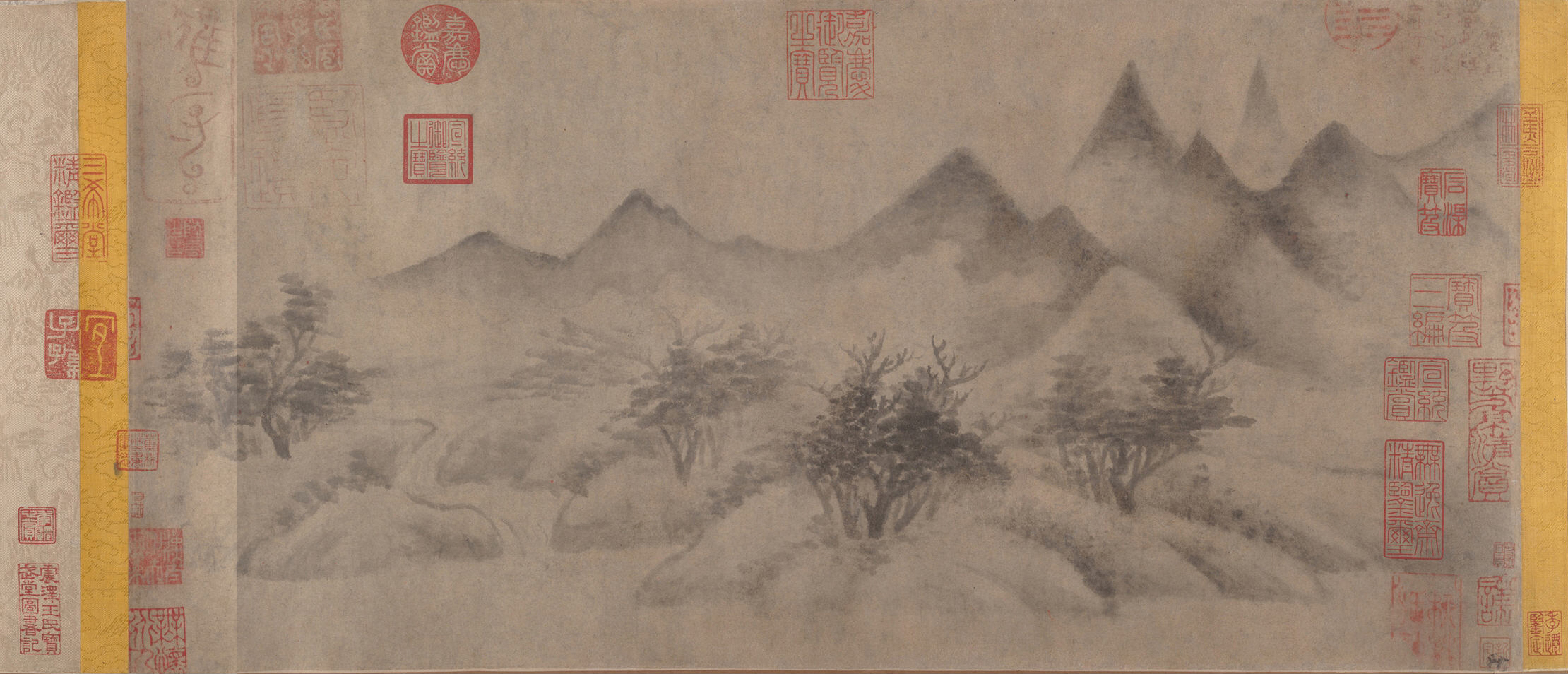
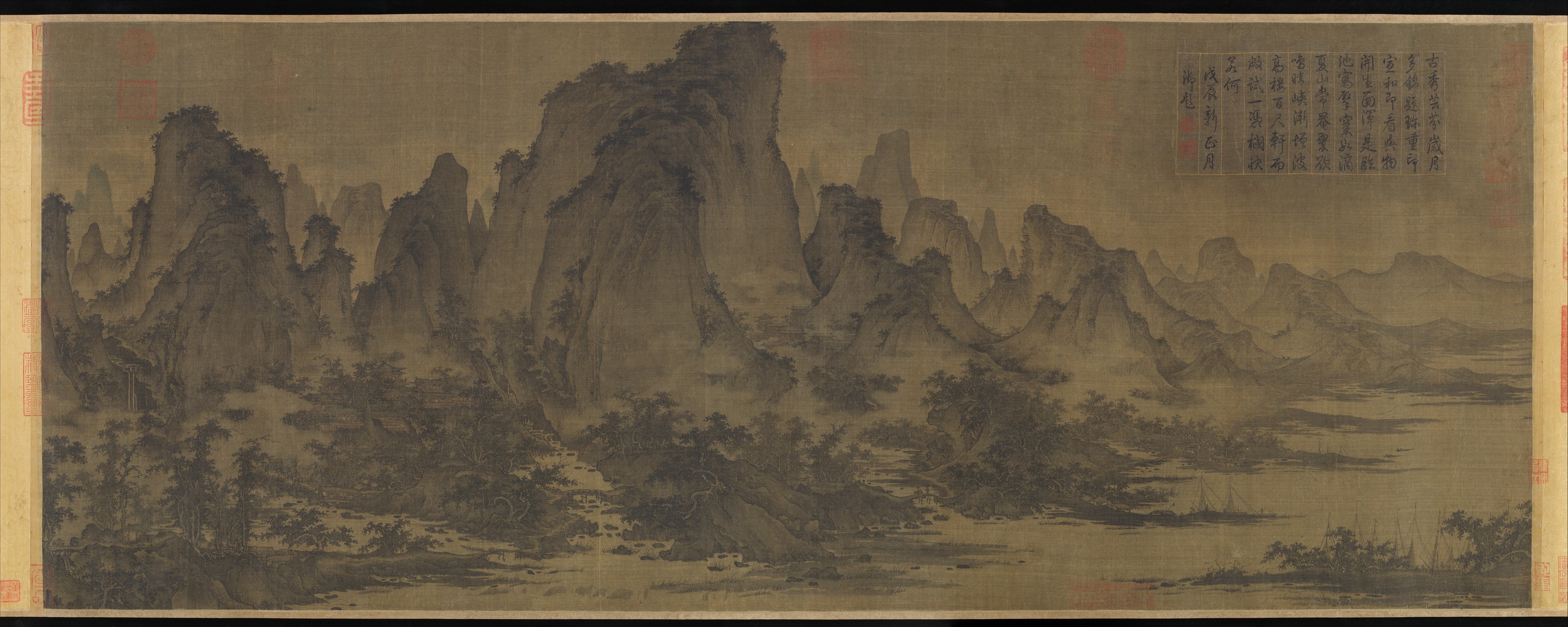
turning to Wang’s Yu-ku-t’u (or Deserted Gorge) and Misty River, Layered Hills, the works Richard Barnhart takes as emblematic of the “profound transformation,” the contrast with Guo Xi is made to appear especially pronounced. barnhart is emphatic about the effects of exile on wang’s painting: writing of Yu-ku-t’u, he remarks, “gone are the noble pines of virtue and morality, gone the structured hierarchy, gone the certainty and clarity, the safety,” and goes on to emphasise the amorphousness and vagueness of the latter work, along with the sense of instability and insecurity it produces in the viewer. wang’s paintings, he argues, introduce, “for the first time in Chinese landscape painting, … the wandering scholar, going nowhere, seeing everything” (barnhart 1994, pp. 198–200).
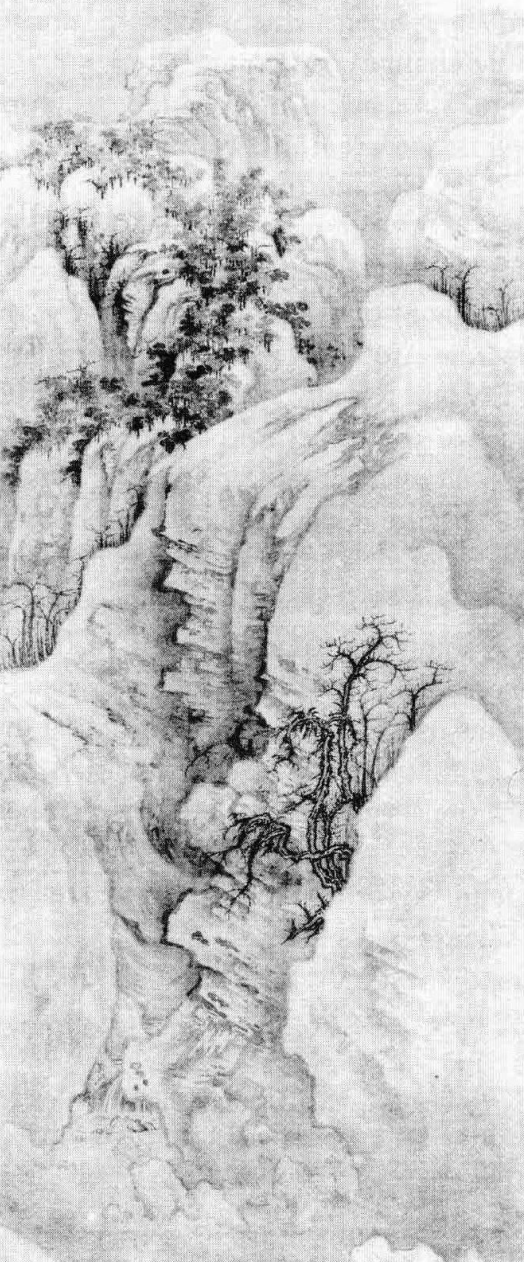
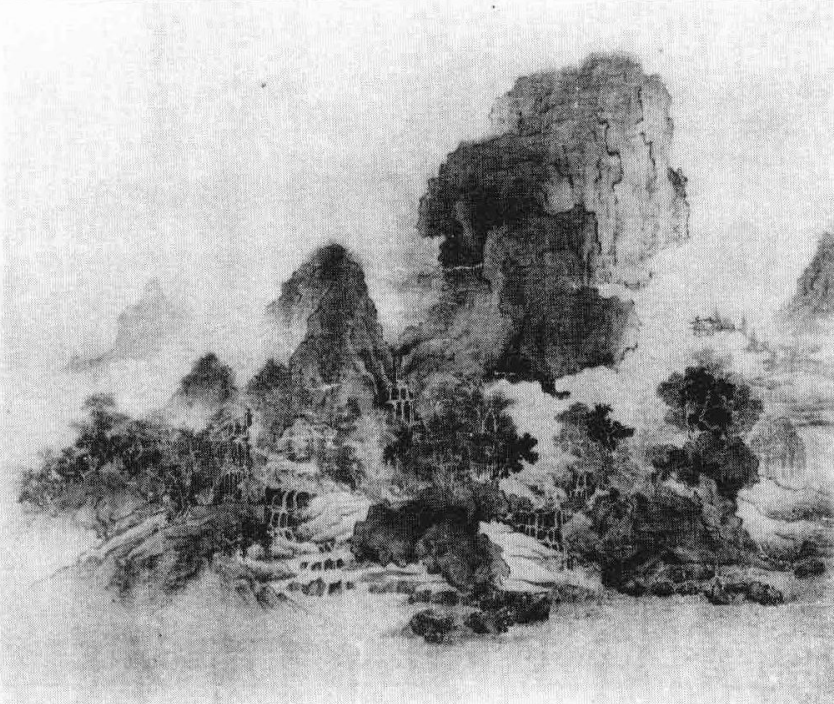
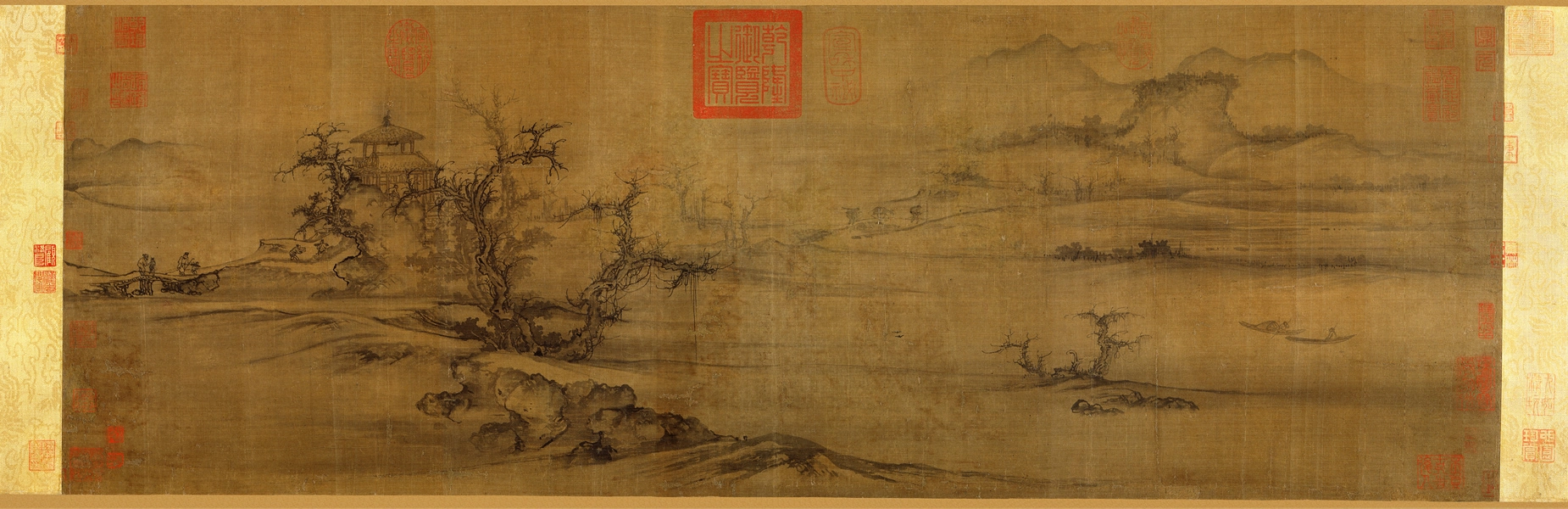
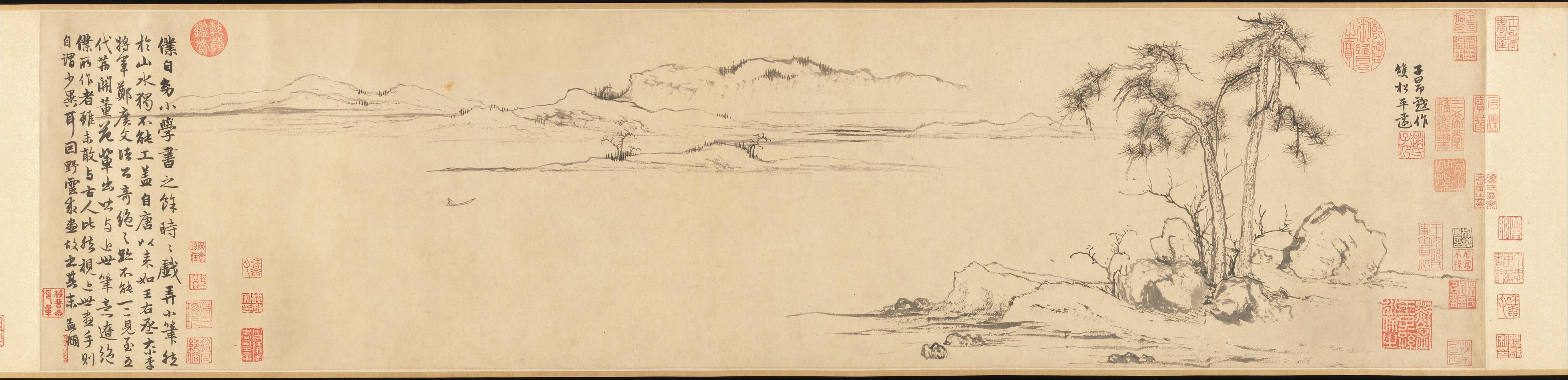
it is difficult to grasp why Barnhart finds Wang Shen’s painting to be such a noticeable departure from Guo’s, and where exactly he locates the “profound transformation.” it is not clear that exile, as in the case of Wang Shen, can be treated as the decisive condition that produces a fundamentally different pictorial mode. if anything, Guo’s text suggests that the kind of absorbed, immersive viewing often associated with exile is already posited as central to painting itself, even for those, such as Guo, fully embedded in courtly life. just take a look at Guo Xi’s own Old Trees, Level Distance.
 click to expand
exile may intensify or extend this experience but it does not introduce it. to set Guo and Wang in opposition on these grounds risks overstating the distinction, as though one painted from within constraint and the other from outside it.
rather, Guo Xi and Wang Shen are working through the same set of possibilities, as articulated in Linquan Gaozhi, a pictorial language that already carries expectations about the behaviour of brush and ink, about how space gathers and thins out, and about the way seeing itself changes when it is tested against landscape again and again, in different light, in different seasons, and from different viewing places. the differences that appear between the two artists take shape from inside this process, as familiar forms are worked over or adjusted, and sometimes pushed farther than before, without ever leaving the ground that made them possible. notably, the essay also makes clear that each painter’s work will give rise to something distinct, and that the formation of an individualistic mode of expression is both expected and necessary within the practice.
Guo’s essay was a guide for strengthening composition and giving it a sense of authority and vitality, rather than an allegory of the real-world political order. in the context of my own personal viewing experience, therefore, the much-cited distinction—between a more hierarchical ordering and a more diffuse, drifting composition—reads less as a some sort of departure than as an inevitable recalibration within a long cultivated artistic tradition that explicitly promotes individual innovation and creativity. the “great man and the virtuoso” is the one who “will not limit himself to one school.” instead, he “cull[s] and compare[s], discuss[es] and investigate[s]” until he can “establish his own school.” this is not optional but it is just what artistic competence looks like for these men. the alternative is also described, and not favourably, for those who “follow one path only, the steps of their predecessors” are confined to repetition, rehearsing inherited forms without deviation. Guo Xi identifies this as narrow specialisation, a lack of “wide practice,” and goes so far as to call such repetition “an evil” that has persisted since ancient times (quoted in Sakashini 1935, p. 33).
emplotment, or: the view from after
the transformation articulated in art-historical studies such as barnhart’s does not assert itself with equal force at the basic level of perceptual experience, i.e., the plain act of looking at the paintings. for an uninitiated viewer, the difference is far less evident, appearing instead as an effect of conceptual overdetermination: it is more readily stabilised discursively, such that one can be taught to see it or map it onto larger art-historical narratives, even as, in the immediacy of looking, the works remain strikingly proximate. for instance, the theoretical contrast Barnhart leans on most heavily is the shift from Guo Xi’s spatial vocabulary to that of Wang Shen’s student Han Zhuo. Guo Xi described three types of pictorial distance: gao (high), shen (deep), ping (level), which is admittedly a very intuitive and teachable system. Han Zhuo later proposed kuo (vastness), mi (amorphousness), yu (mysteriousness), i.e., atmospheric qualities, moods, and so on. Barnhart reads this as some sort of a decisive rupture, a “radical transformation in expectations” (Barnhart 1994, p. 200), and many scholars are wont to take this to much higher levels of abstraction, such as a contrast between Confucian order and something more Daoist.
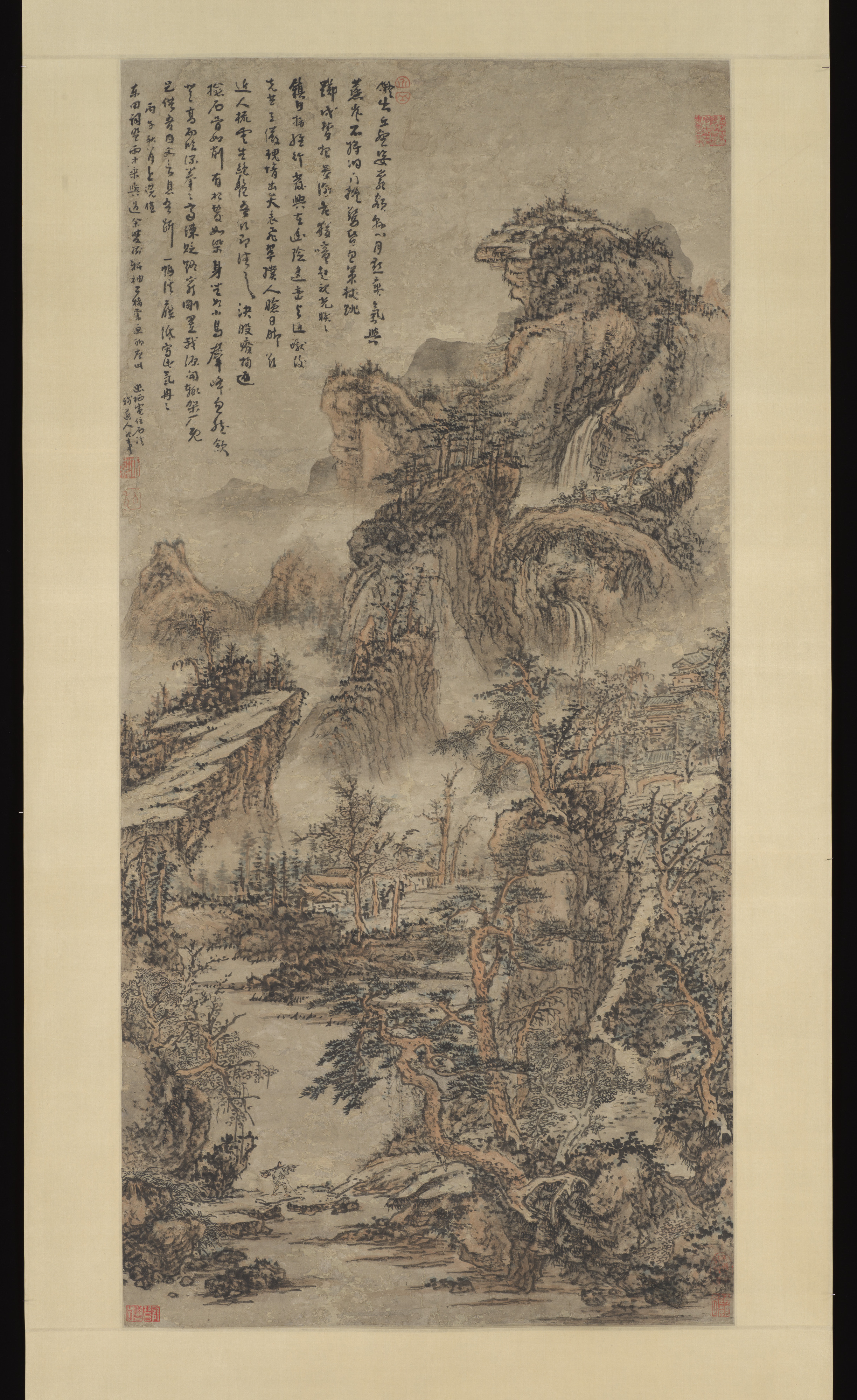
while generative, i am compelled to question whether these are opposing categories or overlapping ones. A high distance can feel vast, deep recession into mist is almost by definition amorphous. A level expanse fading into fog is mysterious. These terms seem less like competing philosophies of the cosmos and more like different instruments measuring different aspects of the same experience of looking at landscape. the passages on the mountain’s shifting appearance makes it difficult to sustain any strong claim for fixed stylistic divisions, since it places variation at the level of perception itself. as Guo Xi observes, a mountain changes with distance, with position, with the direction from which it is approached, so that no single view can exhaust it; what one sees is always partial, conditioned, and subject to change (vividly described in Sakashini 1935, p. 35 onward). differences between painters, including Wang Shen, begin to look less like evidence of a radical shift and more like the inevitable result of situated perception, of looking from here rather than there, at one moment rather than another. Barnhart’s statement that “it is clear from Kuo Hsi’s [Guo Xi’s] writings that he would have found Wang Shen’s art disturbingly different from the ideal he cherished,” (Barnhart 1994, p. 205) asserts a reading that is nowhere evident in the text itself. it reads as a retrospective projection rather than a substantiated inference, and risks foreclosing the possibility that Guo would have recognised in wang’s work precisely the qualities of maturity and accomplishment his own treatise values. viewing a few chinese paintings from this (and a few from the later) era makes the richness and flexibility of this long-developed tradition immediately apparent:
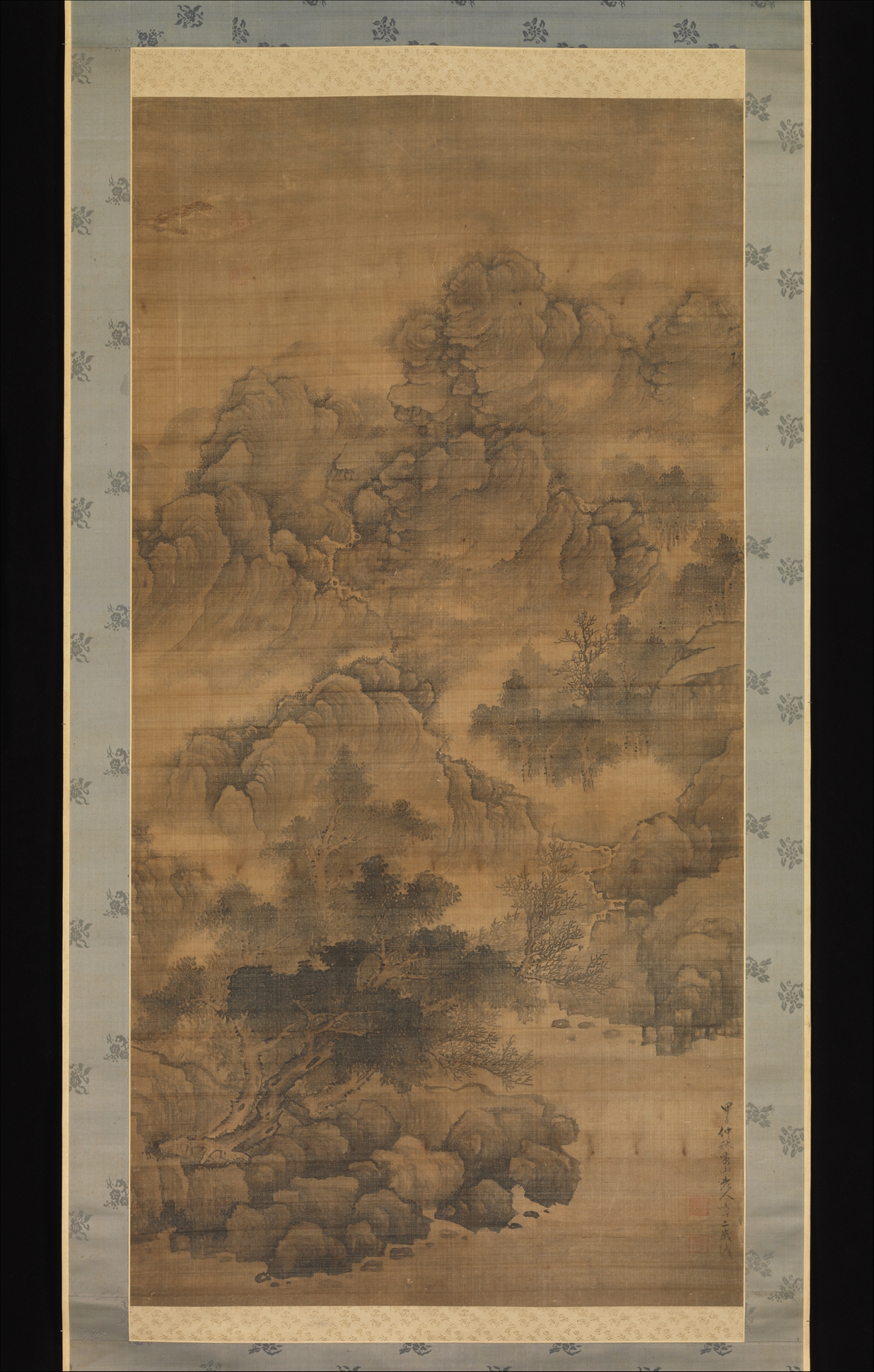
this notion also introduces a different level of concern. the issue is no longer confined to the painting itself, but extends to the conditions under which we now encounter it. for modern viewers, the act of looking is rarely neutral, and anyone approaching these works having already absorbed art-historical narratives is, in some sense, predisposed to see the distinctions those narratives have already laid out.
this is not a new problem. across philosophy, the history of science, and art history, questions of how perception is structured, rather than simply given, have long been central. from Immanuel Kant’s account of the conditions under which experience becomes possible, to Thomas Kuhn’s argument that observation is shaped by paradigms (The Structure of Scientific Revolutions, 1962), anticipated in Norwood Russell Hanson’s insistence that seeing is itself interpretive (Patterns of Discovery, 1958), what one sees has repeatedly been shown to depend upon prior structures of understanding. E. H. Gombrich develops this further through his account of schemata (Art and Illusion, 1960), while Maurice Merleau-Ponty demonstrates how perception is bound up with the body and its situation (Phenomenology of Perception, 1945). in a related vein, Arthur Danto’s formulation of the conceptual framework in “The Artworld” (1964) underscores the extent to which what can be seen in a work depends upon historically specific frameworks of interpretation.
it is striking how often these positions return under new labels in modern academia, but what they altogether continue to insist on is difficult to set aside: that what one sees is never simply given, but already shaped in advance, so that the experience of looking is, from the outset, conditioned.
but historians need periodization. without it there is no narrative, no teachable framework, and no way to organize a field. So we do tend to want to locate ruptures, maybe a political event, an exile, or a manifesto, and use these as pivots around which everything else is arranged. In Time and Narrative (1983), the philosopher Paul Ricoeur defined this as ’emplotment,’ i.e., the operation by which a historian selects and configures events into a story with a beginning, a direction, and a logic (one may also turn to Hayden White’s gorgeous work, Metahistory, 1973). The important thing Ricoeur (and White) noted about emplotment is that it is always constructed backwards. Modern investigators would already possess the knowledge that Wang Shen was exiled, us contemporary readers and painting-admirers already have the thesis by Barnhart, and so you read the paintings in light of a conclusion already in place. The narrative runs forward on the page but was built in reverse.
final thoughts
This doesn’t make Barnhart wrong, exactly, plus I am not qualified to make such a statement. His argument may be acceptable to art-historians who are well versed in the multitude of aspects and events that make the twelfth century what it was under the northern Song dynasty. But my opinion is that, even if there were interesting political shifts, consequences like exile and so on, artistic traditions don’t move on the scale of an event. They move the way Fernand Braudel’s longue durée moves, i.e., at the pace of centuries, through the slow accumulation of practice, largely indifferent to the surface events that political history treats as decisive. and while This is not always the case, as immediate political circumstances can sometimes generate brand new art, or art that breaks from tradition, but with chinese landscape painting in the period under consideration, I see a strong genealogy, an acknowledgement and respect for those who’ve come before, and minor modifications to the craft, something that recalls T. S. Eliot’s account of what constitutes “tradition” in the first palce.
Eliot suggests that tradition is a living simultaneity, where earlier works continue to exist in active relation, and where each new work shifts the whole ever so slightly rather than simply taking its place at the end of a line (“Tradition and Individual Talent,” 1919). Wang Shen, then, was not stepping outside tradition when he painted, but continuing it, and that continuation already involves transformation. repetition, as anyone enthusiastic about Gilles Deleuze might point out, is never entirely “pure” anyway (Difference and Repetition, 1968). and in any case, wang shen himself might not have recognised that he was participating in a “tradition” at all, in much the same way that heavy metal artists today don’t always accept the subgenres they’re placed into by their fans. put simply, every act of transmission alters what is being passed on. tradition takes shape in real time, through use, without requiring some large external rupture to set it in motion.
By the time i looked at these paintings, Barnhart’s emplotment had already entered my vision. His narrative became part of the prefiguration I brought to the act of looking — the prior framework that shaped what I’m able to see before ive even consciously chosen to see anything. Which means the most rigorous thing a viewer such as myself can do is to simply not accept the framework as the condition of seeing, but periodically… suspend it.
what I keep finding, when I do that, is two painters who looked at nature with sustained and serious attention, who understood how mist rises and dissipates, how trees find purchase in rock, how atmospheric perspective causes distant forms to lose their edges and dissolve into the background. That observational acumen is what both artists and their works represent, prior to and independent of whatever differences of mood or composition we might identify between them. It is, to my mind, the more remarkable fact, and the one most at risk of being lost when too absorbed in the search for allegory.
this article is written without the benefit of formal art-historical training and is submitted in the hope that it does not unduly provoke those who possess it.
references
- barnhart, richard. 1994. “landscape painting around 1085.” in the power of culture: studies in chinese history, edited by willard peterson, andrew plaks, and ying-shih yü. chinese university press.
- bush, susan. 2012. the chinese literati on painting: su shih (1037-1101) to tung ch’i-ch’ang (1555-1636). hong kong university press. https://www.jstor.org/stable/j.ctt2854hr.
- foong, ping. 2000. “guo xi’s intimate landscapes and the case of ‘old trees, level distance.’” pt. 87-115. metropolitan museum journal 35 (2000). https://www.journals.uchicago.edu/doi/10.2307/1513027.
- liao, ziting. 2023. “spiritual travel in chinese landscapes: travelers among mountains and streams and murals from yulin caves.” journal of education, humanities and social sciences 23 (december 2023): 391–99. https://doi.org/10.54097/ehss.v23i.12924.
- murck, alfreda. 2000. poetry and painting in song china: the subtle art of dissent. 1st ed. vol. 50. harvard university asia center. https://doi.org/10.2307/j.ctt1dnn9rx.
- murray, julia k. 1994. “art-historical perspectives on the song: studies on song painting.” journal of song-yuan studies, no. 24 (1994): 355–72.
- zhang, du. 2022. “chinese landscape painting from the perspective of ‘integration of man with mountains and rivers.’” november 21, 2022, 59–64. https://doi.org/10.55060/s.atssh.221107.011.